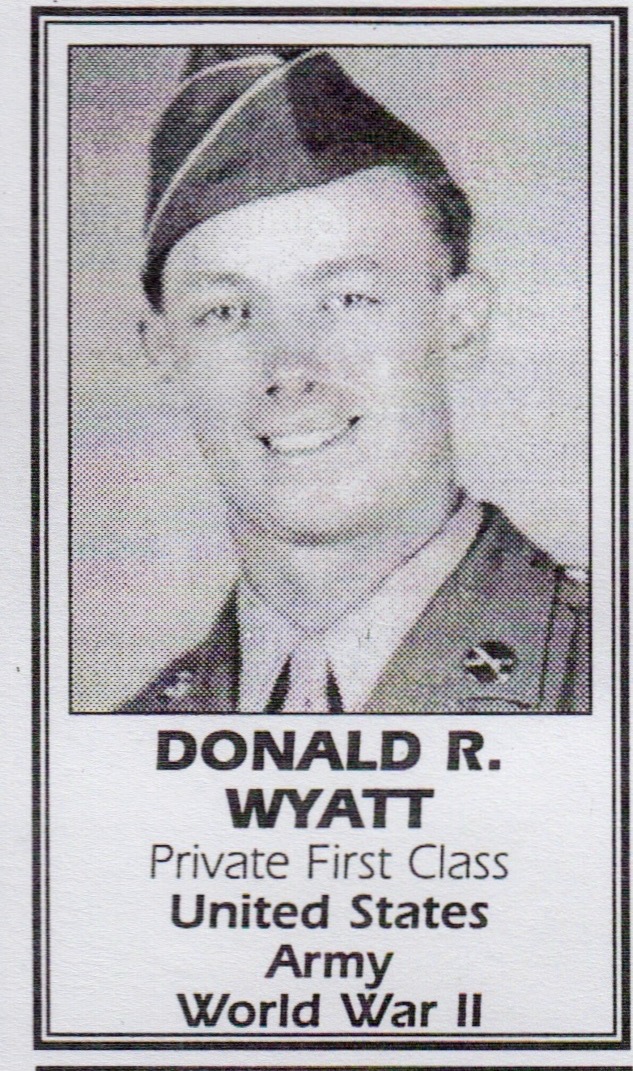
Most of my friends in the 1960s recounted WWII stories told by their dads. I wanted to tell stories, but my Dad almost never mentioned the war. In fact, whenever the war was mentioned, he might share a trivial tidbit, but then quickly change topics – he was drafted between his junior and senior years in high school, held in a fenced area with armed guards awaiting the troop train in St. Louis, had basic training in Camp Polk Louisiana, sailed on the first troop ship to land in France following D-Day, remained above deck on the stern during the entire Atlantic crossing, saw Uncle Dale and Uncle Gordon in England, was a telephone lineman, received a purple heart in Worms Germany, and was hospitalized in Brigham City Utah. That was all I knew; I wanted to know more, but never felt comfortable asking. As Dad’s Alzheimer’s disease progressed, memories – good or bad, took on an allure to him that they hadn’t previously possessed. I would drive to Missouri and sit with Dad while Mom worked as an Election Judge. On one occasion, Dad was sitting upright in his blue recliner and I was sitting in Mom’s mauve swivel rocker. Dad was looking across the living room and out the window when he began talking out loud, “It was a crisp clear day in February. It was still cold, but the bright sun had caused the snow to begin to melt in places. Orders came that a line was down between battalion and one of the companies. My buddy and I got into a jeep and began driving down the line, which was strung along the ground. We soon found the place where a tank or half-track had crossed the line and cut it in the mud and snow. We quickly made the repair and headed back before dark. I told my buddy to let me out and I would turn in the paperwork while he checked the jeep back into the motor pool. I was walking across a large paddock where we and other soldiers had marched many times. As I headed toward the chateau headquarters, a mine exploded under my left heel knocking me to the ground.” Mom told me that several of Dad’s friends started to rush into the paddock to drag him to safety, but Dad insisted that he was ok and he would crawl to them rather than taking a chance on someone else getting hurt. He once told her, “I was always grateful that I was alone and no one else was hurt.” Dad never spoke of the war again. Most people didn’t even know my Dad had an artificial leg, much less a purple heart. They were shocked when he occasionally left it off, pinned up his left pant leg, and used his crutches. I recall the first time our pastor saw Dad on crutches and asked, “What happened to your dad?” “Nothing that I’m aware of.” “It looks like he has lost his leg.” To which I replied with a smile like l had heard Dad many times before, “No, he didn’t lose his leg. He knows exactly where it is. He will be putting it back on later today or maybe tomorrow!” Dad never viewed himself as a hero, he never begrudged the sacrifice he had made, he simply viewed his service as something that had to be done – the Nazis had to be stopped, and then to get on with life. Tom Brokaw was probably right, his may have been our greatest generation.


 Bradley Roberts Wyatt
I enjoyed your story about your Dad.
LikeLike
Love this, I never knew half of all this. Miss him truly
LikeLike
Good story. That was the greatest generation.
LikeLike