She Can Marry Whomever She Wants

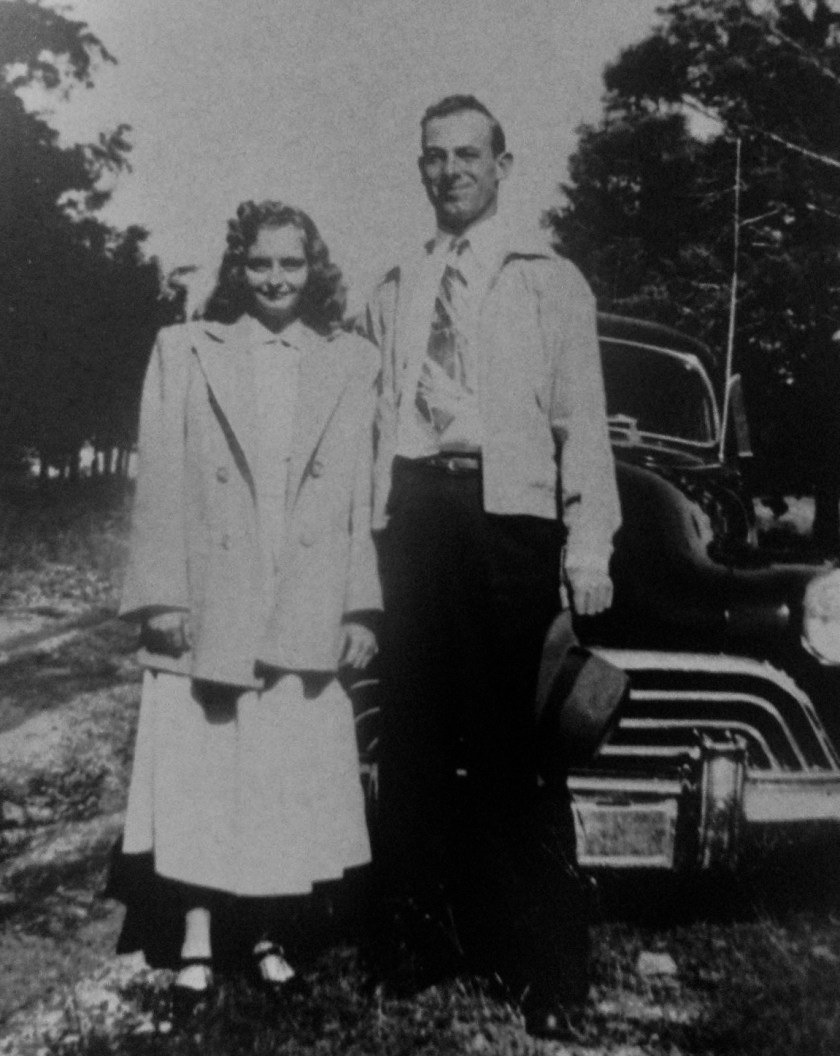
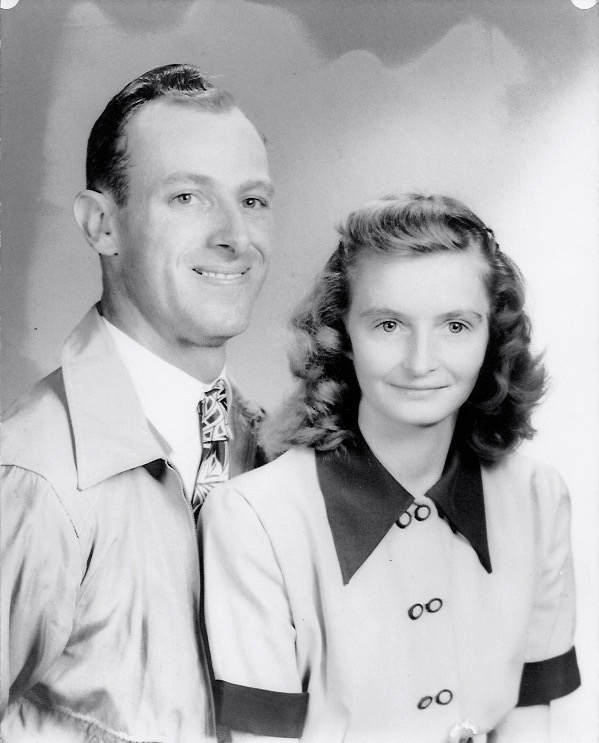
After the war, Dad returned home to finish his senior year in high school.  His experiences in WWII made the students seemed immature and foolish, but he persisted and graduated from Forsyth High School on the sixteenth day of May, 1946.  Mom graduated two years later on the fourteenth day of May, 1948.  I don’t know how they met, but I believe Dad started courting Mom after she graduated.  They eventually fell in love and decided to get married.  Mom, whose parents never owned an automobile nor learned to drive, was very proud that Dad drove a shiny new, 1947 Oldsmobile Sedan.  In those days, you didn’t tell your parents you were getting married; you asked for their permission.  So Dad dutifully drove his Oldsmobile to Old Hilda to ask Preston Ira and Nola Weaver Roberts permission to marry their youngest daughter, Ruby Dean Roberts.  Pres was easy – he had two simple requests: (1) they needed to wait until Ruby turned eighteen and (2) they needed to be very certain of their decision.  Nola was a different story.  When Dad asked her permission to marry Ruby, Nola told him matter-of-factly, “She can marry whomever she wants!”  Dad was caught off guard by Granny Roberts’ bluntness.  He misinterpreted her response to mean Granny really wanted Ruby to choose someone else.  She actually meant exactly what she said – Ruby, not Pres and Nola, should choose whom she wanted to marry.  Regardless of her intent, Dad set out to win Nola over.  Early on, he and Mom would come to Pres and Nola’s house every Saturday night; Dad would play cards with the boys and Mom would spent time talking with the girls and helping in the kitchen.  After Pres and Nola moved to Oregon, he drove Mom to Hood River so she could spend time with her parents during the Christmas holidays.  Later, he opened their home to Mom’s family and had the privilege of having many members of the Roberts family stay with them over the years.  After Grandpa passed in 1959, Dad built a small bedroom for Granny on our enclosed back porch.  This small bedroom became her home until her death in 1979.  As Granny aged and her health declined, she grew very fond of Dad and would often ask Mom to get him to help lift or move her.  It greatly pleased Dad that Granny would ask for him by name.  During the days that I stayed with Mom following Dad’s funeral in 2011, she said, “I believe my family truly loved your Daddy . . . and I think my mom [Nola] was pleased with my choice”.  I think she was right.
Scan 71

IMG_5555

It was a Crisp Clear Day in February

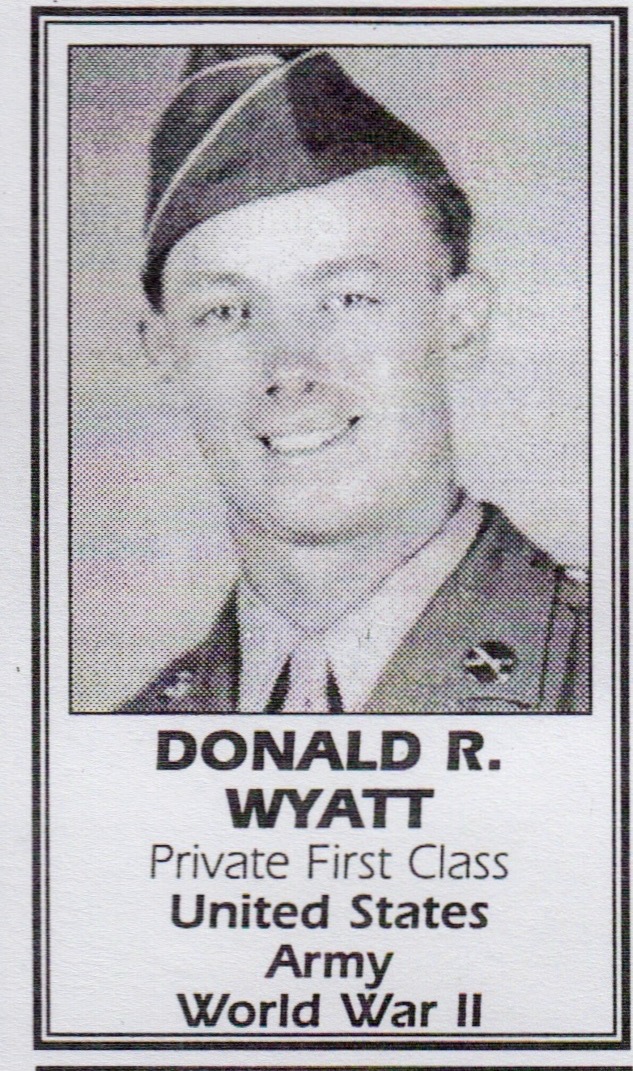
Most of my friends in the 1960s recounted WWII stories told by their dads.  I wanted to tell stories, but my Dad almost never mentioned the war.  In fact, whenever the war was mentioned, he might share a trivial tidbit, but then quickly change topics – he was drafted between his junior and senior years in high school, held in a fenced area with armed guards awaiting the troop train in St. Louis, had basic training in Camp Polk Louisiana, sailed on the first troop ship to land in France following D-Day, remained above deck on the stern during the entire Atlantic crossing, saw Uncle Dale and Uncle Gordon in England, was a telephone lineman, received a purple heart in Worms Germany, and was hospitalized in Brigham City Utah.  That was all I knew; I wanted to know more, but never felt comfortable asking.  As Dad’s Alzheimer’s disease progressed, memories – good or bad, took on an allure to him that they hadn’t previously possessed.  I would drive to Missouri and sit with Dad while Mom worked as an Election Judge.  On one occasion, Dad was sitting upright in his blue recliner and I was sitting in Mom’s mauve swivel rocker.  Dad was looking across the living room and out the window when he began talking out loud, “It was a crisp clear day in February.  It was still cold, but the bright sun had caused the snow to begin to melt in places.  Orders came that a line was down between battalion and one of the companies.  My buddy and I got into a jeep and began driving down the line, which was strung along the ground.  We soon found the place where a tank or half-track had crossed the line and cut it in the mud and snow.  We quickly made the repair and headed back before dark.  I told my buddy to let me out and I would turn in the paperwork while he checked the jeep back into the motor pool.  I was walking across a large paddock where we and other soldiers had marched many times.  As I headed toward the chateau headquarters, a mine exploded under my left heel knocking me to the ground.”  Mom told me that several of Dad’s friends started to rush into the paddock to drag him to safety, but Dad insisted that he was ok and he would crawl to them rather than taking a chance on someone else getting hurt.  He once told her, “I was always grateful that I was alone and no one else was hurt.”  Dad never spoke of the war again.  Most people didn’t even know my Dad had an artificial leg, much less a purple heart.  They were shocked when he occasionally left it off, pinned up his left pant leg, and used his crutches.  I recall the first time our pastor saw Dad on crutches and asked, “What happened to your dad?” “Nothing that I’m aware of.”  “It looks like he has lost his leg.”  To which I replied with a smile like l had heard Dad many times before, “No, he didn’t lose his leg.  He knows exactly where it is.  He will be putting it back on later today or maybe tomorrow!”  Dad never viewed himself as a hero, he never begrudged the sacrifice he had made, he simply viewed his service as something that had to be done – the Nazis had to be stopped, and then to get on with life.  Tom Brokaw was probably right, his may have been our greatest generation.

Veterans 2

New Posts Each Week!

My goal is to post new stories each week until I run out of stories or ticks on this clock or brain cells that want to cooperate!  I will start with the stories I wrote about my dad after he passed in 2011.  Next, I will share the stories I wrote about mom after she passed in 2013.  I have a story about my deer hunt in Colorado that I plan on posting in November if I can find the pictures.  Eventually, I will get to “The Float Fishing Trip”, which will be the story of Roberts family that settled along Caney Creek in Taney County in the late 1800’s.  The next post will be on Thursday, September 21st.  I hope you enjoy!

“Sis, Take Care of Your Mom”

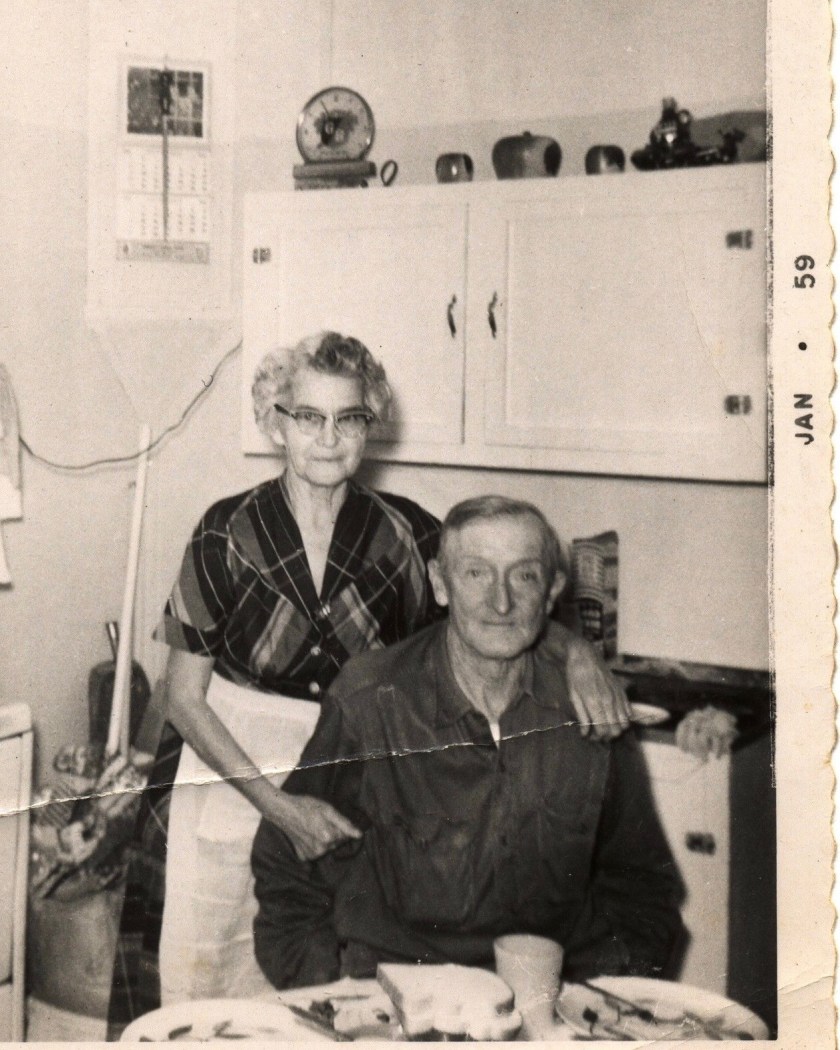
1959.p-n.02In the winter of 1958-59, Grandpa Pres and Granny Nola came back to Missouri from Oregon to spend Christmas with the family.  Just prior to leaving to go back to Oregon, Grandpa Pres had a very short conversation with my Mom and simply said, “Sis, if something happens to me, I want you to take care of your mom”.  In March of 1959, Grandpa Pres died of a heart attack in Oregon.  For the next 20 years, Mom took care of Granny Roberts – at first simply checking on her as she lived in Forsyth, then taking her into our home when she became very ill in the early 1960’s and where she would remain until her death in 1979.  There were times when we would want to do something, but Granny wouldn’t feel good enough.  Mom would simply say that she wanted to stay with  Granny.  Sometimes we would go on without Mom and Granny; sometimes we would stay at home with Mom and Granny, but I can never recall a single occasion in which Mom was not faithful to the request that her Daddy had made so many years before.

The Christmas Goose

The Dust Bowl and Great Depression were not kind to Granddad and Grandma Wyatt.  In 1930, they returned to Missouri after the drought made it impossible to continue irrigation farming in Maher, Colorado.  Arter and his brother, Truman, loaded their families and all their belongings into two cars and drove nearly 1,000 miles from Maher to Taney County Missouri.  One of the cars didn’t have a heater, so they heated a large stone each night by the fire, then wrapped it in a quilt each morning and set it in the floorboard to warm Ada’s feet as they drove.  Unlike Grandpa and Granny Roberts, who had a creek bottom farm that provided ample food for their large family, Granddad and Grandma Wyatt struggled to survive with three growing boys and one daughter moving from farm to farm along the flat, dry ridge running from Taneyville and Dickens to Kissee Mills.  Grandma Amy made the most of everything including an occasional ham bone that was used to make multiple pots of pinto beans and often shared with a neighbor who had nothing to flavor their beans.  Any hint of meat with a meal was a special treat in those days.  Dad vividly recalled one bitter Christmas when a lone goose landed on the large pond behind Cum Williams’ barn.  Granddad Wyatt took the 22 rifle, sneaked over the pond bank, and, with a single shot, dispatched the goose.  Four excited and likely hungry children watched as Grandma Wyatt carefully plucked the goose and placed all edible parts into a large Dutch oven.  As the goose baked, the house was filled with a pleasant aroma and hope that was far too scarce during the Depression.  Seven decades later, Dad still vividly remembered the goose as the most wonderful meal and best Christmas of his childhood.

Welcome!

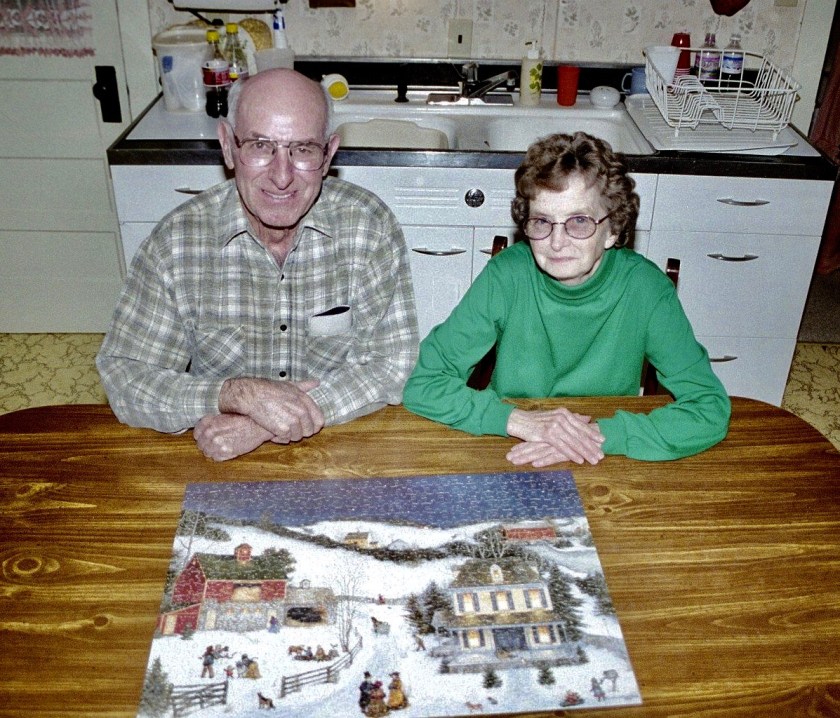
This blog is being written in loving memory of my remarkable parents to preserve their story for those who knew and loved them.  My goal is to capture their essence in a series of simple stories that were etched into my memory.  – Bradley Roberts Wyatt

HighRes_WF32A031150363915