I am neither a healthcare professional nor an expert on Alzheimer’s care giving. But, I thought it might be helpful to some to share our adaptations through a series of short stories of our experiences while caring for my Dad and my Mother-in-Law on this long journey known as Alzheimer’s.
It was a Saturday evening in late January at our farmhouse in the Missouri Ozarks. Mom was busy in the kitchen preparing dinner. Dad and I were in the living room; Dad in his favorite chair and I in the swivel rocker nearby. There were several relatives visiting with us and the small house was filled with voices and laughter.
The shadows stretched across the holler where the farmhouse was situated and the living room windows began to darken as the winter light waned. Mom went outside briefly, then came back inside after feeding their Kimmie dog. “It’s getting cold out there!” she said as she walked toward the kitchen.
Dad signaled with his left hand that he wanted me to come to his chair. As I got up and leaned closer, Dad kept signaling for me to bend nearer and nearer to him like he had something important to say. When my ear was literally inches from his face, he whispered, “I’m ready to go home.”
Over the years, I’ve observed caregivers try to explain that we are already at home or even engage in an argument with the patient. We had quickly learned the futility of that approach with my Dad.
As I raised up, I simply said, “Dad says it is time to go home; who wants to go with us?” Our family had learned that “going home” meant a 15-30 minute car ride around the community before we returned for dinner. My brother said he would go along; others said that they needed to leave for the day.
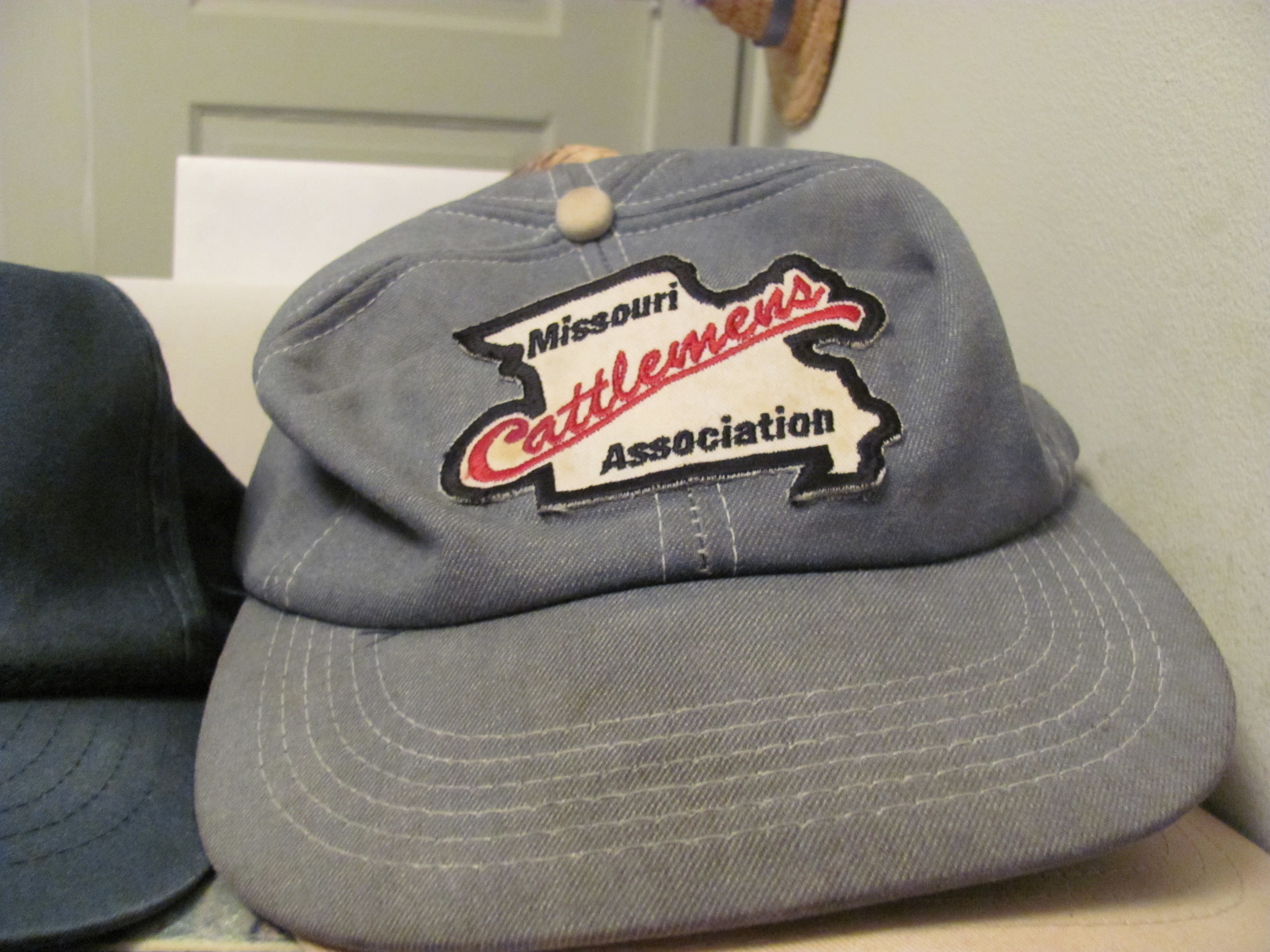
Mom came into the living room and said, “Don, your gonna need a coat and a cap if we’re headed home.” She proceeded to slip on her coat and knit toque hat, then grabbed Dad’s fleece-lined denim jumper and Missouri Cattlemen’s Association cap. I helped Dad out of his recliner and held him while Mom pulled on his coat and cap.
I continued to hold onto Dad as we walked out into the cold. Mom and I helped him climb into the front seat of my Honda Ridgeline and buckled him in. Mom and my brother climbed into the back seat while I got into the driver’s seat and started the engine. I flipped on Dad’s electric seat heater and turned the truck heater to max. He seemed to chill easily as the disease progressed.
“Dad, are you ready to go home?” I asked to keep him on track of our activity. He said, “Yes I am” as we drove onto the County Road running in front of the farmhouse. We deliberately drove along familiar roads and pointed out locations that Dad could still remember from the distant past.
At one point, I asked, “Dad, didn’t you go to grade school here in Dickens?” “Yes, I did; that’s the store, but I don’t see the schoolhouse.” We continued our drive circling back toward the farmhouse repeating the routine at each familiar landmark. As we drove back into the driveway at the farmhouse, I didn’t leave anything to chance and said, “It’s good to be back home!” hoping that Dad would reply, “Yes it is!” which was our signal that the short drive had been effective.
I got Dad out of the truck and helped him into the house. Mom helped him remove his coat and cap and sat him back into his favorite chair. Without missing a beat, Mom said, “Now that we’re back home, would you like something to eat?” To which Dad replied, “Yes I would!”
It has always amazed me that a short ride in the car and some well placed conversations would help Dad find a renewed sense of security in his favorite chair and an internal feeling that he was “home”. We repeated the drives almost every evening during the twelve years of Alzheimer’s. I eventually discovered the car rides were amazingly beneficial to the patient and the primary caregiver who desperately needed a few moments of normality outside of the confines of our farmhouse.
Blessings to the caregivers and those on this journey.
Growing up, everything and everyone had a purpose which contributed to the family’s survival. Parents both worked, kids had chores, and even dogs had a specific purpose which was generally explained by the adjective before their name – rabbit hound, bird dog, coon hound, squirrel dog, and cow dog. These rules applied to everyone and every beast equally except for my cousin Joy. For some inexplicable reason, Joy could chose any dog she wanted regardless of it’s usefulness, and she generally chose a dog toward the more useless side. And so it was with her dog, Kimmie. A veritable ball of fur with no real purpose in life but to run and eat. We later learned that Kimmie was a Keeshond, which is a Dutch version of a Huskie or a German Spitz. Dad initially disdained Kimmie and gave her the nickname of “Sooner” because “that dog would sooner eat than do anything useful”.
As circumstances changed, Joy could no longer keep Kimmie at her house and asked my Mom and her Aunt if they would temporarily keep Kimmie in their dog kennel. Joy knew better than to ask her Uncle Don if he would provide room and board for an animal as useless as Kimmie. As time passed, temporary became permanent and Dad became determined to make something useful out of Kimmie.
The challenge was almost insurmountable. Kimmie was a virtual ball of energy; if she got loose on the farm, she would run from one ridge down across the County Road and creek and up to the top of the opposite ridge, then back again and again without so much as stopping. She would make six or eight trips from ridge to ridge as Dad walked the quarter mile to the bridge below their house and back.
But, Dad was determined. He started the training process by placing a lasso around Kimmie neck and holding on for dear life. Kimmie would pull so hard that Dad could barely keep from being jerked down and would sometimes snub the rope around a tree like a cowboy with a bronco. Mom was concerned that the rope would cut off Kimmie’s windpipe and kill her. Dad said, “it won’t choke her if she will stop pulling!” And so, the battle of wills proceeded. Eventually, Kimmie appeared to relent and would sit patiently in the dog kennel as Dad placed the lasso around her neck for the walks to the bridge and back. Dad was convinced he had trained Kimmie to heel. If dogs could talk, I suspect Kimmie would tell a different story of how she had trained the human to walk her twice a day.
When it was time to go to the vet, Dad would lower the tailgate of the truck, pat it with his hand and Kimmie would jump effortlessly into the bed of the truck and wait for Dad to tie her in so she couldn’t get too close to the edge. By this time, Dad had become quite attacked to Kimmie and took a great deal of pride in “his” dog! Kimmie also took great pride in her owner and became very defensive of the homeplace. She would run the fence line of the dog pen barking loudly anytime man or beast came near the yard.
Several years passed when Mom and Dad returned to the house from a routine trip to the grocery store. In the dog pen were two Doberman Pinschers with no sign of Kimmie dog. As Mom and Dad got out of their car, the two Doberman Pinschers rushed the fence and tried to bust through. Dad shouted to Mom, “get inside the house as quickly as you can”. Mom shot back, “you need come inside and call your brother Dale to come help”. As Mom dialed the phone, she could see the Dobermans shaking the mangled carcass of their beloved Kimmie. Mom told Dale of the situation and told him to come quickly and bring his gun . . . loaded. When Dale arrived, Dad eased out the front door with his loaded, pump-action .22 rifle in hand. He and Dale met on the carport; “I will take the one on the left; you take the one on the right”. When the Dobermans charged the fence, Dad and Dale opened fire. Soon, three dog corpse lay still in the pen.
Years later, Dad told me that he knew it was wrong, but it felt good to shoot those dogs that had jumped the fence and killed Kimmie. He asked Dale to take the carcasses of the Dobermans and dump them near the waterfall. “What about Kimmie?” Dale asked. “She deserved better than that; I will bury her in the pasture” Dad replied.
During my next trip to Missouri, Dad and I walked to the bridge below the house and back. I fought back tears as I watched Dad walk with lasso in hand, but no Kimmie dog along side. It was one of the saddest things I have ever seen. I became determined to remedy the situation by years end. I searched the internet and eventually found a Keeshond dealer in Poteau Oklahoma. We arrived at a price and agreed that we would meet at the City Park on the Friday evening before Christmas with cash in hand. As we pulled into the City Park around 10:00 pm, Pam asked, “Are you certain this is a good idea? To meet someone we had never met, in the middle of the night, knowing we were carrying a sizable amount of cash, with your wife and two children in the car?” Well, when she put it that way, it really didn’t make a lot of sense. When we pulled into the parking lot, another vehicle slowing pulled in near us. They seemed equally reluctant to get out of their car. I pulled my coat tightly around me as I stepped out of the car into a frigid December night. Much to my relief, a lady with a beautiful Keeshond puppy stepped out of the other car. I introduced myself, paid her the agreed upon price, and loaded the puppy into a kennel in the back of our SUV. Our children were ecstatic and wanted to hold the puppy in their lap, but I simply said there will be time for that when we get to Grandma’s.
The next morning, my brother and family arrived for Christmas and we presented Dad with his new puppy. Because of the cost of the dog, we had agreed we would split the expense three ways. Steve, wanting to make Dad feel extra special, told him, “you must be really loved for us to buy you a dog costing three hundred dollars!”. I couldn’t resist the opening and interjected, “Dad, the dog only cost $200; I told Steve $300 so he and Mom would pay for it and I would still get part of the credit!” The look on my brother’s face was priceless! He wanted to believe I was just teasing, but also wanted reassurances that he hadn’t been bamboozled by his little brother!
So, Dad had a new dog for Christmas and all that remained was naming the puppy. By this time, Dad was already suffering with some memory problems, so we quickly agreed that the new dog would be named Kimmie, since that was what Dad was already calling her. As we left for Texas, Dad was in his chair, Mom was in the kitchen, and Kimmie had taken up residence on the enclosed back porch until the weather warmed up. When spring arrived, Dad and Kimmie began walking to the bridge and back twice per day until Dad’s health no longer allowed these walks.
Looking back, I guess my cousin Joy knew more about the usefulness of things than I had ever imagined.
(ADVISORY:THIS STORY MAY NOT BE ENJOYABLE FOR ANYONE WHO IS SENSITIVE TO HUNTING.)
Saturday, November 2, 1996
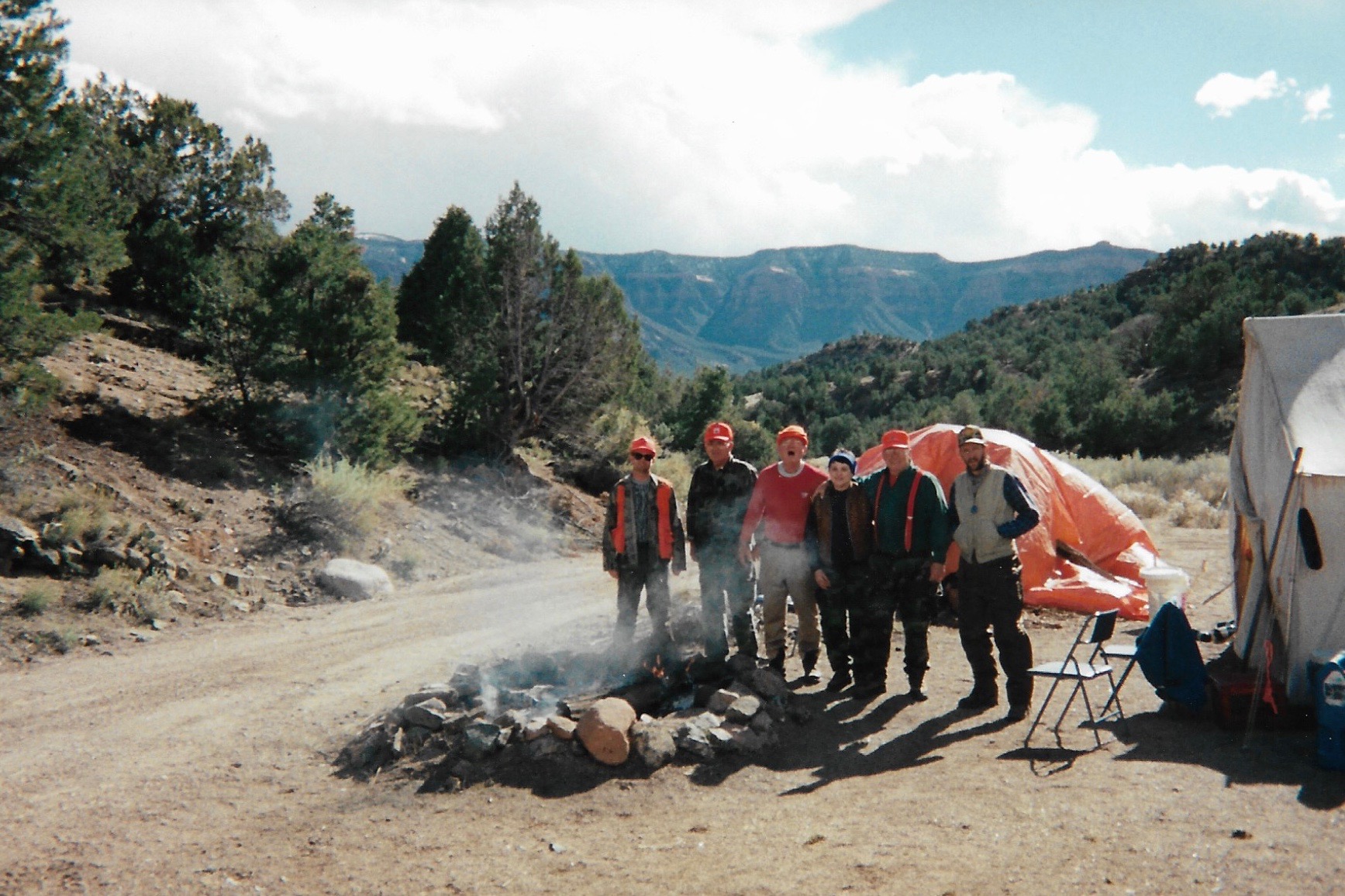
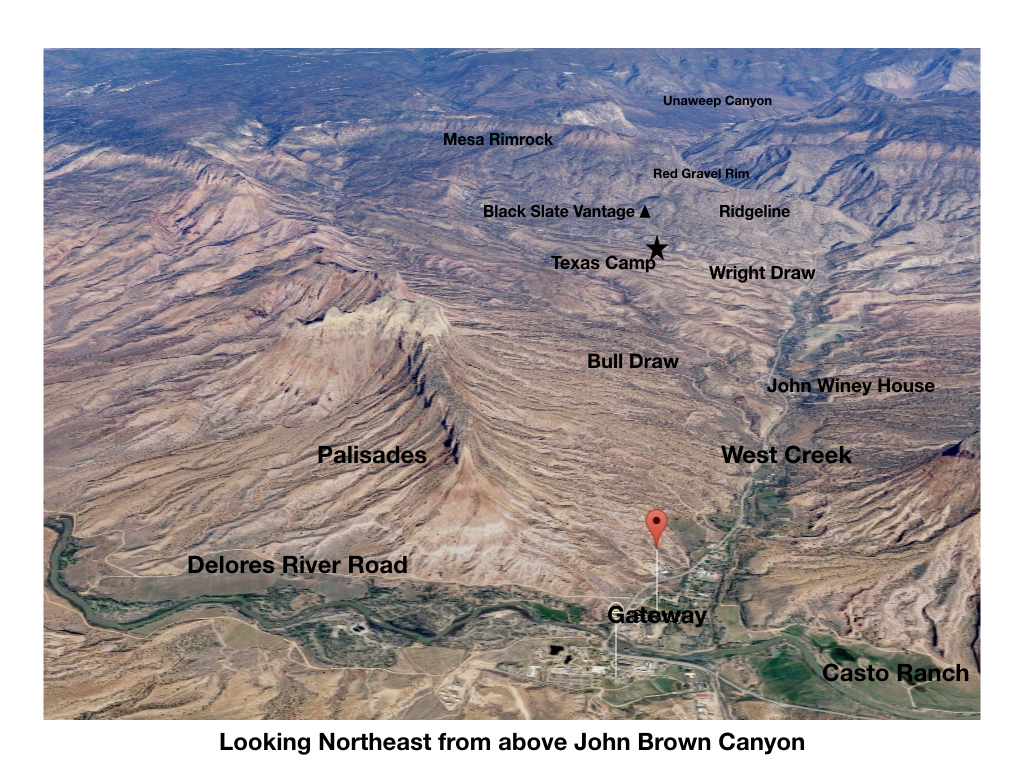
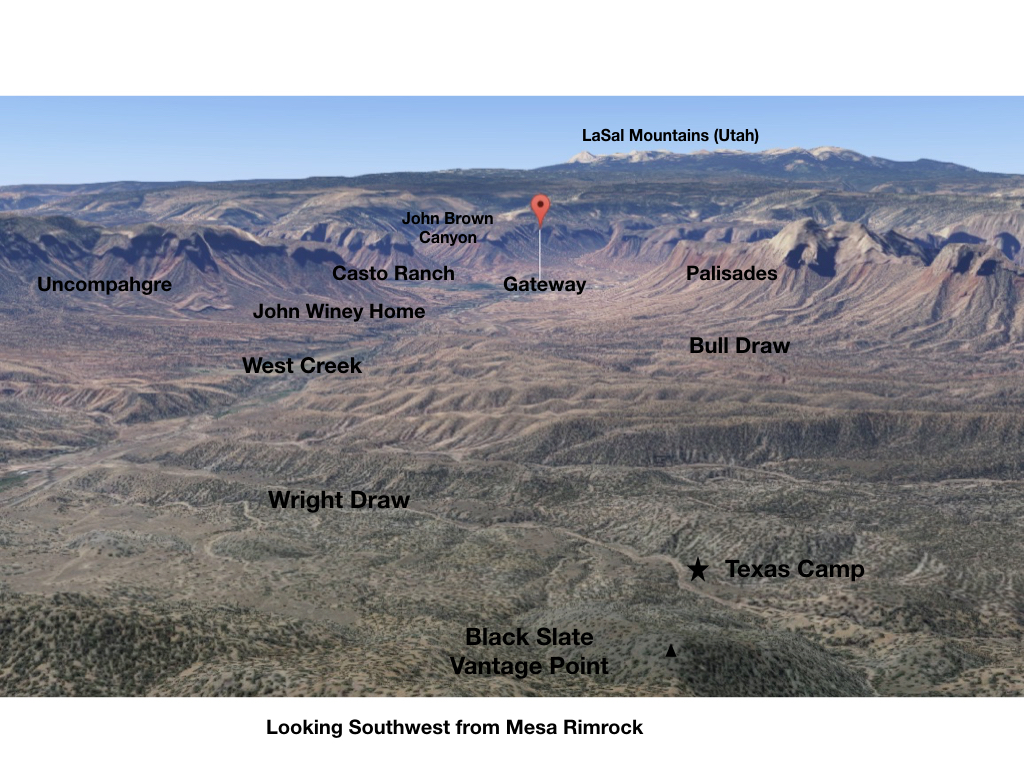
I left camp in Wright Draw at 5:10 am.Climbed the east side of black rock knoll by 6:05 am.Climbed 10 steps; breathed in and out 10 times; climbed 10 more steps.
At 7:30 am, I saw the first deer.It was off to the right about 300 yards down and across the canyon.Suddenly, three more appeared.Now, too many to count.My heart was racing as I desperately scanned each deer for antlers.No antlers, just does, a total of nine.Once spotted, they were easily seen.But, if you looked away for even a second, they would blend into the gravel and rocks and simply vanish.Only to reappear magically with a flick of the ear or a single step.
Two does made their way up and beyond the canyon and over the rim.Others came up the canyon and crossed the red gravel saddle between the black rock knoll and the red gravel rim.Suddenly, two does were within 50 feet on the black slate rock immediately below me.They were following a trail that ran within 10 feet of my vantage spot.
(Previously, I had been scoping the deer looking for horns.It was like an arcade; here’s a deer, find it in the scope, no horns.There’s another deer, find it in the scope, no horns – another doe.Wait, have I checked that one?What about the one to the right?)
Now, I was frozen.The doe was 50 feet away.She didn’t know what I was, but she could sense that I was out of place and didn’t belong.I was motionless.She knew something was different, but couldn’t figure out what it was.Finally, after what seemed like an eternity, she eased silently back down the slate rock and out of sight.I could breath again!I sucked in deep breathes of air and tried to convince my heart to stop pounding as the adrenaline was metabolized out of my veins.
At 8:30 am, another deer appeared in the canyon below.This one was different.I put the scope to my eye and the sun burst into face.All I could see in the scope was the net covering my face and reflecting back off the lens.I jerked my cap and netting off while panic set in!
My next attempt at looking though the scope, fighting the sun, finding the deer.Horns extending past the ears, good deer.I drew in and the gun fired.The deer jumped to the left and ran up the hill toward the rim.Three more shots ran out with no indication of stopping him.
Suddenly, he stopped behind a piñon bush about halfway up the hill.I can’t see him, but I knew he was there.I wait patiently for 30 minutes with my scope fixed on the piñon.My muscles began to ache from being motionless under the weight of the rifle.Finally, the deer stepped out from behind the bush broadside, 250 yards away, uphill.This time, I took a proper rest, put the crosshairs high on his shoulder, took a deep breath, let it halfway out, and squeezed the trigger.The shot ran out and the deer bolted up the hill.I squeezed off another shot as he crossed the rim and out of sight.
Waiting another thirty minutes, I carefully marked the trail followed by the deer on the only paper I had – my Colorado deer license.I meticulously marked each spot where shots had occurred.I stripped down to lighter clothing and prepared to cross the canyon to the deer trail.
As I climbed the hill and reached the location of the first shot – nothing, no hair, no blood, nothing.I continued to slowly climb the steep, red gravel hill; 10 steps, 10 breathes, without any indication that I my bullets had found their target.At the piñon, I saw tracks where the deer had turned back on itself and where the fifth broadside shot was fired.The tracks cut deep into the gravel where the deer bolted up the ridge.I found a small bone fragment, a piece of fatty tissue, and a bit of white hair, but nothing more.Definitely no blood.
I continued climbing toward the top of gravel rim with no additional indication that the deer had been hit.I stopped at a rock outcropping for 30 more minutes to rest and watch for movement.I eased over the top of the rim, I found another small piñon along the deer trail.Underneath the piñon tree, I found a spot of blood about the diameter of a Coke can.Twenty more steps down the trail I found another blood spot; then a third blood spot another twenty yards beyond.Then nothing.
I spent the next two hours walking along the rim and down into the red gravel bowl on the backside.I followed every set of fresh tracks – nothing.I crossed the red bowl at fifty foot intervals without any success.It was impossible to tell which direction the deer went once it dropped out of sight over the rim.
At 1:00 pm, I left the red gravel rim for camp; exhausted, dejected, frustrated.I couldn’t believe that I missed, not once, but four times and even my fifth shot was not a kill shot.When I arrived back at camp, I briefly repeated what had happened, but it was obvious that I didn’t want to talk and no one else wanted to climb the ridge to assist in looking for the deer that would never be found.I ate a light lunch and drank some water, then lay down for about 30 minutes before it was time for the afternoon hunt.
At 2:30 pm, I climbed toward the black slate rock knoll again.I sat silently for the next two and one-half hours bewildered that I may have missed my one and only chance for a Colorado mule deer.At 5:06 pm, I saw several does, but no bucks, coming down the cattle trail that leads from the top of the mesa to the red gravel rim.I hoped and even prayed that the injured buck would magically appear with them, but to no avail.I used a flashlight to walk slowly back to camp.Exhausted.
Sunday, November 3, 1996
I woke dat 4:30 am.David and John had left between 3:00 to 3:30 am to ride four-wheelers to the Delores River Road.Since it was Sunday, I packed my copies of “Experiencing God” and “My Utmost for His Highest” into my backpack.In a previous hunt, I had walked back from the black slate hill and drove to church in the valley on Sunday.However, this time I knew I wouldn’t have the stamina to make two trips up the ridge.
At 5:00 am, I began my climb to the black rock knoll by moonlight.I climbed ten steps and breathed ten times.Occasionally, I would begin to panic and start thinking I wouldn’t get there before daybreak and would forfeit any opportunity to redeem myself.But, when this would happen, I would climb ten steps and breath twenty times.I had learned on a previous trip that the panic attacks were caused by a lack of oxygen due to the altitude and physical exertion.It took a good deal of mental discipline to fight back the panic and slow down until oxygen was restored when every fiber of your body wanted to bolt up the hill.
When I arrived at my vantage point on the black slate hill, I sat down by a dead cedar and scattered my stuff out, keeping it all within arms reach.While it was still dark, I dug into my backpack and put on my long johns and heavy clothes.Clouds began to move in covering the moon and a light rain began to fall.I zipped up my devotionals and other stuff in my backpack, sat on my insulated coveralls, and shivered in the rain.The wind came up and I was forced to put on my insulated coveralls and my last of my layers of clothing.
At 7:30 am, the rain stopped.Nothing was moving.No does, nothing.When 8:30 passed, there was still nothing moving.The rain began again and I moved up the hill under a piñon tree, covered my cope with a leather glove, and tried to keep out of the cold wind.
Sometime later, the rain stopped, the sun came out, and I took off my insulated coveralls when I warmed back up.All too soon, the sun was gone and the cold wind began blowing again.I put on my coveralls for the second time.
At 10:00 am, HE topped the red gravel rim.As he started down the trail, it was obvious that HE was a massive buck – his antlers were well past his ears.HE came right down the hill, running hard, but not pogo sticking.Near the bottom of the hill, where the two trails intersect, HE stopped beside a tree and looked at straight at the black slate hill where I was sitting.
(When he first topped the rim, I began self-talk: wrap the sling around your left arm, take a rest on both knees, put the crosshairs on the deer, aim low if shooting down hill, take a breath, let it half out, squeeze the trigger, see the deer drop out of the scope after the shot is heard and recoil is felt.Don’t take a running shot; wait for him to stop.)
When the buck stopped and looked up at the black slate hill, I took aim low on his left shoulder,let out half of a breath, squeezed the trigger, and watched the deer in the scope as the shot rang out and the recoil was felt.
Initially, he didn’t react to the shot.He ran further down the hill, into the canyon, and almost out of sight.Then, he turned back up the hill toward the rim, stumbled, and fell.But immediately, he got back up and continued down the ravine out of sight. Fearing he would get away, I got up and cut across the black rock knoll to get a better view of the canyon below.Suddenly, I spotted deer running through the cedars and around the knoll to my right.A sick feeling came over me.This deer was also going to get away.The deer disappeared over the knoll before I could see if the buck was among them.
I sat down for a few minutes before deciding there was only one thing to do; go down and check for a blood trail.I shed the heavy clothes and coveralls and dropped over the knoll into the canyon, crossed the ravine, and climbed to the point where the trails crossed.There, beside a piñon tree, I found the spot where the buck had turned up the hill and stumbled.This time, therewas blood, lots of blood, and heavy tracks in the gravel.I followed the tracks down the ravine.About twenty yards away, there lay a deer, on it’s side with massive antlers extending well above the body.
I approached cautiously looking for signs of life with my rifle ready to fire.Seeing no movement, I eased closer, dropped the rifle,grabbed the antlers and held on for dear life halfway expecting the buck to come back to life and bolt away.When the buck still didn’t move, I realized it dead and slowly released my grip on the antlers.I pulled hard on the antlers, but could only barely budge the deer.I knew I would have to go back to camp for help, but didn’t want to leave the deer without ensuring it was dead.I didn’t want to ruin the cape by cutting his throat, but also didn’t want to take a chance that he would get away.I eventually field dressed the deer and climbed back up the black slate knoll for the rest of my gear.
As I walked back to camp, I was elated to have killed a nice buck, but I was also exhausted from the events of the previous day.I was simultaneously proud and sadden; proud that I was able to bag a buck, but saddened that such a majestic animal would no longer range freely over the rimrock in Mesa County.
When I reached camp, I told them that I had killed a deer and would need some help getting it back to camp.David and I rode a four-wheeler down Wright draw to the highway, then drove back between the ridges to within about a thousand yards of the ravine.When we walked into the ravine, David was astounded at the size of the buck and antlers.Why hadn’t I told them that I had killed such a massive deer?I really couldn’t answer that question; I guess it was because my parents had such a disdain for pretentious people.Better to simply let others decide forthemselves.
I asked David if we could drag the deer down the ravine to the camp.We scouted the area below and found that the ravine plunged over ledge rock that would be impossible to navigate by ourselves, much less with a deer carcass.Our only way out was the way we had come in.We attached a rope to the deer’s antlers, David climbed to the closest piñon tree and snubbed the rope.I would lift the deer up the slope and David would take up the slack.For the next 100 yards, I would lift the deer while David pulled hard on the rope, then would snub it on a piñon tree while I climbed another step up the hill.Eventually, we reached the top of the ravine and dragged the beast another 900 yards along the side of the ridge to the four-wheeler.
On the way back to the camp, we were stopped by the Colorado Fish and Wildlife officer.Once again, my heart sank as I recalled stories of violators losing their game, guns, and vehicles.The officer wanted to check my rifle; I told him nothing the chamber, but the magazine was full, which was legal in Colorado at the time.He checked my deer license; it was properly filled out and attached to the buck.Finally, he simply congratulated me on a nice deer and wished us a safe journey home.Exhausted and relieved, we arrived back at camp with my buck.
Our celebration was short lived; John arrived at camp, congratulated me on the nice buck, and told David and me to get in the truck and head to the river where he had also killed a buck.His deer was about 3000 yards from the roadway toward the Palisades.As we were walking in, we heard and saw some Native Americans hunting against the rimrock that ran to the Palisades.Shortly before we arrived at John’s buck, a shot rang out and we realized they had also bagged a deer.They were probably three times farther away from the road than John’s deer.We began dragging the buck toward the truck; one on the right antler, one on the left antler and one walking behind resting.When we couldn’t pull any longer, we would rotate from right to left to resting.About halfway out, the two Native Americans came walking past us, their buck draped across the shoulders of one of the young men and the rifle being carried by the other.As they walked past, one of them spoke some native words, the other laughed, and they walked on out of sight.I’ve always assumed they were not impressed by the three Caucasians and our ineptness of dragging a deer across the mesa.
Monday, November 4, 1996
Since my hunting was over, I lay in bed until well after sunrise.My body relished the rest.We had skinned both deer that evening and carried the carcasses and heads with capes attached to the local meat locker.They dutifully hung my name on my buck and John’s name on his buck.We made arrangements to pick up both deer on Thursday before we left for Texas.
I eventually got out of bed, cooked some breakfast, then climbed to ridge behind the camp.From my vantage point, I could see down West Creek, across the Dolores River valley, and up John Brown Canyon toward the La Sal mountains in Utah.I found a place to sit among some large rocks on top of the ridge.I sat and read from my devotionals as I watched a snowstorm dust the mesa on the far side of the Dolores River.I was amazed and humbled by a place so stark and enchanting.As I read my devotional, I wondered if it was a hill like this where Abraham offered up his son Isaac or Moses saw the burning bush or Jesus sought a solitary place to pray.My thoughts turned to the magnificent buck and the one that got away and the terrain where they were born and lived out their life.I sat for a long time thinking about life and listening to Garth Brooks on my Sony Walkman cassette player and wondered if the injured buck would be the one the wolves pulled down.
“Wolves”
January’s always bitter But Lord this one beats all The wind ain’t quit for weeks now And the drifts are ten feet tall
I been all night drivin’ heifers Closer in to lower ground Then I spent the mornin’ thinkin’ ‘Bout the ones the wolves pulled down
Charlie Barton and his family Stopped today to say goodbye He said the bank was takin’ over The last few years were just too dry
And I promised that I’d visit When they found a place in town Then I spent a long time thinkin’ ‘Bout the ones the wolves pull down
Lord please shine a light of hope On those of us who fall behind And when we stumble in the snow Could you help us up while there’s still time
Well I don’t mean to be complainin’ Lord You’ve always seen me through And I know you got your reasons For each and every thing you do
But tonight outside my window There’s a lonesome mournful sound And I just can’t keep from thinkin’ ‘Bout the ones the wolves pull down
Oh Lord keep me from bein’ The one the wolves pull down
I didn’t know at the time, but I would only have one more hunt with Jerry, Della, David, John, Henry, and Ed in Wright Draw before my dad would fall ill with Alzheimer’s disease and I would began spending my hunting vacation with my parents on our farm in Missouri.But, at this moment, I simply savored deer hunting in Colorado.
At 2:08 am on Monday morning, April 30th, I drove my truck down the driveway for the last time. All the remaining items from the house that had served as our home for almost 39 years were packed into the bed and back seat. The house lay empty, silent, and dark behind me. There were no nightlights glowing in the windows of the children’s bedrooms, no late night swimmers in the moonlit pool, no teenager’s cars parked on the driveway, no birds on the feeder or squirrels on the ground below.All that remains is a quiet house and my memories.
I filled the birdfeeder with black oil sunflower seeds earlier in the day as I wondered if the new owners would continue feeding the critters after we were gone. I thought about the fox kits that visited this time last year, the green bean vines in the small plot in the back yard that I began growing after Mom and Dad could no longer garden, and the flower beds that I had watered one last time before leaving. It has been a good house, a great home, and wonderful place to spend our lives together.
We moved into this house the week of our first wedding anniversary in 1979; Pam, myself, and our Heidi dog.Over the years, our home was graced by seven miniature dachshunds – Heidi, Gretel, Madalyn, Lucy, Spencer (Big Buddy), Chloe, and Trisha.At first, we had no fenced in yard, so I would sit at the top of the steps and watch Heidi’s every move as she walked along the curb in the street light.Eventually, we installed a pool and fence and would let the dogs out in the back yard.Lucy insisted on sniffing every inch along the fence.Big Buddy, who had incredibly tender feet, would take two steps on the damp grass, then relieve himself on the patio.When finished, he would either walk backwards to get back on the patio or make two big jumps to get turned around and back on the dry concrete.
We brought Justin home to this house in January 1982.He arrived earlier than expected in December 1981.Fortunately, a case of jaundice allowed me enough time to get the baby furniture assembled before he was released from the hospital.
Jordan arrived in October 1987.Before her arrival, Pam and I were “experts” on raising children with the compliant Justin.We should have realized from the beginning that Jordan was destined to be an attorney.The defining moment occurred when she came home from daycare, crossed her arms, looked us in the eye, and said in a matter-of-fact tone, “My name is Emily and that is what you will call me”.
The large oaks in the front yard were transplanted from the undeveloped woods where the La-z-boy furniture store is located.Loop 281 was two lanes through the woods in those days as compared to six lanes for traffic, two shoulders, and a limited access turn lane.The retaining wall was built by Pam and I using her 1973 Volkswagen Beetle to transport the railroad ties.I carried on end of the tie while Pam drove the VW with the other end on the bumper.The storage building in the back was built with our own hands; Dad told me to make it 10’x16’ rather than 8’x12’ like I had planned and use treated lumber.We added a pool in 1985 and spent many sultry summer evenings swimming with our dear friends Randy, Micki, and Super Dave.
We will miss the sunrises that brighten the kitchen in the morning, the noonday sun that warms the pool and deck during the day, the evening sunsets behind the live oak, and the glimmer of the moonlight on the pool.We will miss the azaleas and dogwood blooming in the spring, the green beans in the garden, and the bees working the pentas and Mexican heather throughout the summer.We will miss Jace ringing the doorbell, asking if Justin is home as he walks to the pantry and grabs a Pepsi on his way out the garage door on his way home.We will miss the warmth of the raised paneling of stained ash in the den and wainscot.We will miss family and friends and laughter at birthdays and holidays.
As I drove down the driveway, I whispered a soft prayer thanking God for blessing us with this home and asking Jesus to give Pam and I grace as we transition to a new home.
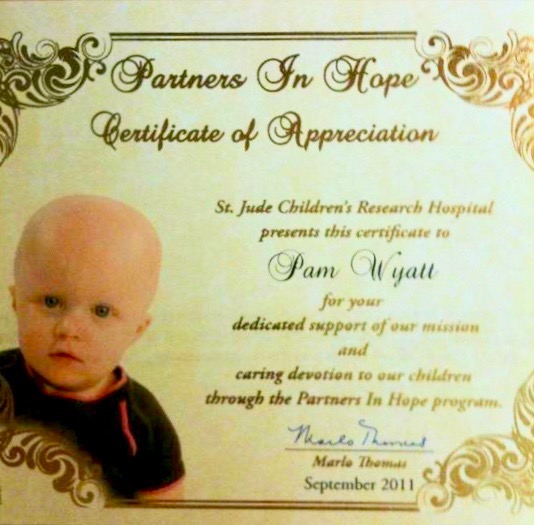
For many years, Pam and I have gotten ready for work each morning listening to Big D and Bubba on KNUE radio out of Tyler, Texas. In 1996, KNUE joined the St. Jude ‘Country Cares’ telethon. From the first broadcast, Pam found it impossible to put on her eye makeup while listening to the touching stories from St. Jude. She immediately wanted to become a “Partner in Hope,” but wanted me to make the call. Even though I fully supported the cause, I was so busy at work that I simply didn’t have time to make the call. I told Pam she could make the pledge; it was as simple as calling 1-800-323-HOPE.
That evening, I was sitting in the kitchen watching ESPN SportsCenter and eating a snack when Pam arrived home. I asked her, “How did your day go? Did you call St. Jude?”
“Yes, I called St. Jude, but it didn’t turn out exactly like I imagined. After I arrived at work, I asked a co-worker to help me, put my phone on speaker, and dialed the number. When the phone was answered, the lady on the other end of the call offered to ‘fulfill my wildest fantasy’. Realizing I had misdialed and reached a porn line, I frantically tried to hang up the phone, but couldn’t get it to disconnect. Finally, after what seemed forever, I was able to hang up the phone. I didn’t know whether to laugh or cry, but eventually looked up the correct number, redialed and made our pledge. Later that day, I met with my supervisor to inform him that I had inadvertently called a porn line on the bank’s phone. He asked if I had hung up immediately and I related the story again about the speaker phone and how I hung up as quickly as I could.”
By this point in the story, my attention had drifted back toward ESPN while trying to also listen to Pam. I became increasingly focused on ESPN when I distinctly heard Pam say, “ . . . and the lady knew you . . .” Immediately my head whipped toward Pam and all attention was focused back on her. “No way”, I said, “No way that lady on the porn line knew me. Why did you say that?” Pam realized I had lost track of her story and answered, “Not the lady on the porn line. The lady taking St. Jude pledges knew you. She had worked in the labs before retiring from Eastman.” Sheepishly, I admitted that I knew the lady from Eastman taking pledges for St. Jude’s.
Over the years, Pam and I have often laughed about how we became “Partners in Hope.” We have been touched by those we have been privileged to help through our modest donations – a child on a flight to Memphis, our dear Skylar, and many others. We encourage others to join us as “Partners in Hope,” but be careful how you dial!
(The current number is 800.822.6344 or stjude.org)
(Today is my father-in-law’s 88th birthday. Here is one of my favorite stories about Bro. Voss.)
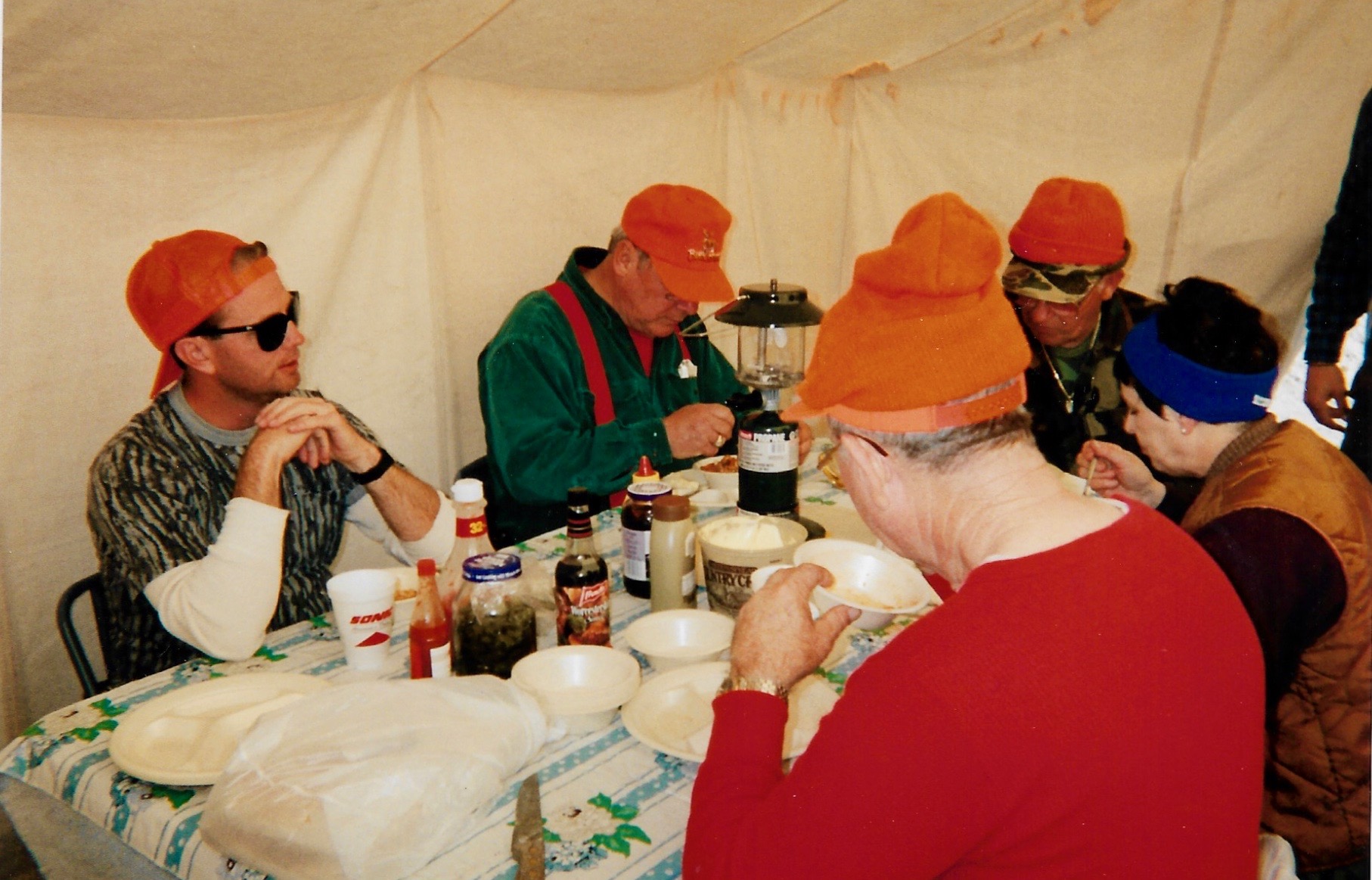
My father-in-law, Bro. Voss, hunted deer in Marion Count for many years after they moved to Texas in 1966. He loved to stay in his pop-up camper while hunting at the lease. Forever the optimist, he would bring all the essentials to the deer camp except meat, confident that the Lord would provide.
On one particular hunting trip, neither Bro. Voss nor I had managed to get a deer, so it appeared that we might have to take the “drive of shame” back into Jefferson to join other unsuccessful hunters buying meat at the Piggly Wiggly. Fortunately, Bob, one of the day hunters on our lease, came into camp with great news – he had shot a deer, but couldn’t find it. Desperate for “camp meat”, Bro. Voss and I agreed to forgo our evening hunt to help Bob find his deer.
As we went to find the lost deer, it became obvious that Bob, although a very good hunter and brilliant in many aspects, was seriously deficient in finding directions in the woods. After wandering around for quite some time, it became apparent that Bob was not looking for his deer, but was simply trying to find his stand. Ever the diplomat, Bro. Voss begin to ask Bob which stand he had been hunting and quickly veered us toward the lost stand and deer. Putting Bob in the stand, we asked which direction he had shot. Walking less than 50 yards in the direction he pointed, we came upon the “lost” deer exactly from where it had been shot. As Bro. Voss and I dragged the deer back to camp, Bob expressed concern that we seemed to be walking in the wrong direction.
At camp, we discovered that Bob had no provision to transport the deer back home in his small car. In fact, he only had a small cooler that would require the deer to be almost completely processed for transport. Bro. Voss and I processed the deer and iced down the meat in his cooler. Bob thanked us helping him find and process his deer, then got into his car and left without leaving us a sniff of camp meat.
I looked at Bro. Voss in utter disbelief, “I can’t believe after we found his deer, dragged it to camp, skinned and processed it, then he left without offering us some camp meat!” With a twinkle in his eye, Bro. Voss said, “I was afraid he might do that. That’s why I took the tenderloins and hid them by the carcass!” Later that evening, as Bro. Voss and I sat down in the camper to a delightful meal of fried tenderloin, he told me, “There’s only one thing better than fried deer tenderloin, that’s STOLEN fried deer tenderloin!” I guess the Lord does provide, sometimes in “mysterious” ways!
Years later, we continued to laugh about the stolen tenderloins, but Bro. Voss softly confessed that he believed the Lord Jesus and his friend Bob had both forgiven him.
As a child of the 1950’s, my earliest memories have slowly faded from the brightly colored experiences of life to the gray tones of the black and white photographs tucked away in dusty boxes, forgotten drawers, and yellowing albums. One of those black and white memories is celebrating our birthdays growing up. It’s a cold winter’s day in January and I am making my annual pilgrimage to back home to once again celebrate my only sibling’s birthday like we have for over sixty years.
I truly cherish the time spent with my brother and the way it reconnects me to those happy times growing up together. But, that wasn’t always the case. I guess all kids compete for their parents’ affections; some driven by simple sibling rivalry and some driven by an inner inferiority that causes us to question if maybe, just maybe, mom and dad really don’t like us as much as our siblings. Then, in our child’s mind, we concoct examples to prove that our parents not only like us as much as our sibling, but actually like us more.
I can vividly recall competing for mom and dad’s affections growing up. My brother, who is two and one half years older, was always stronger, faster, and smarter than me. He had all of the firsts – first to go to school, first to get to drive, first to move away from home. If I weren’t so young at the time, I would also remember he was the first to walk, the first to talk, and the first to do all those baby things that were captured in so many photos of him and so few photos of me. So, as a kid, I tried to construct at least one example that would show that Mom and Dad still liked me, if not the best, at least equally.
Eventually, I decided that on our birthday celebrations were the clearest evidence of the way Mom and Dad really felt about their two sons. Steve’s birthday fell on January 24th. After we arrived home from school, we would celebrate his birthday with our normal family meal followed by a birthday cake and presents. Then, it was off to do homework before bedtime. Occasionally, his birthday would fall on a weekend and we didn’t have to do homework so we could have cousins over to help celebrate on an otherwise cold and dreary winter day.
My birthday, on the other hand, fell on July 29th. We would celebrate my birthday at the creek. We would swim, fish, cook hot dogs and marshmallows over a campfire, open birthday presents on the gravel bar, and always have plenty of cousins to help celebrate. To top it off, Dad only consistently took off work on two days per year – Christmas and my birthday. What more evidence was needed than Dad taking the day off work on the birthday of our Savior and on MY birthday?
Years later, I realized the celebrations had nothing to do with the level of affection of our parents and everything to do with the season of the year. The celebration of my birthdays at the creek had more to do with Mom reminiscing about her own childhood growing up on the banks of Beaver Creek and Dad remembering courting the Roberts’ youngest daughter at Old Hilda than the birthday of their youngest son.
Now, I cherish my brother’s January birthdays and the time we get to spend together on the family farm. Often, we simply do the chores that I despised as a child and relish as an adult. Shortly before her death, my mom told me that nothing, absolutely nothing, that she and Dad had accumulated over the years – the farms, the house, the treasured trinkets, their bank accounts, nothing, would be more important than the relationship with my brother . . . and she was so right!
Mom and Dad were among the most generous people I have ever met. Their home was always open to others. I never recall a time when we did not have another member of the family staying with us. Sundays were a special day in which everyone gathered to enjoy a meal together after church. I recall Sundays when as many as 40 or more people would stop by the house to see Granny, enjoy lunch together, the men would talk and talk, and the kids would play in the creek behind the house – totally ignoring the admonitions to not get wet. As years went by, Mom and Dad begin to rely upon Steve and I to help them make decisions. Many of the decisions seemed trivial – they wanted to help or do something special for a friend or relative or grandchild. Some of the decisions were major – Mom and Dad helped both me, my brother, and maybe others purchase our first homes. Regardless of the expense, Mom would call and simply say, “Your Dad and I would like to do the following. We think the Lord Jesus would be pleased. What do you think?” I would chuckle under my breath thinking, “Does Mom really think I’m going to say no to something she and Dad believe would be pleasing to the Lord Jesus?” I would simply reassure Mom that, “Yes, I also think the Lord Jesus would be pleased”.
(In Loving Memory of my Uncle Gordon and Aunt Nomal Jo Goetz)
When I received word that my Uncle Gordon Goetz had passed, I remembered how he saved my life in the fall of 1958. That fall, my brother Steve started first grade leaving me and my cousin Stanley behind. We spent the warm fall days riding Steve’s pedal-driven tractor and my tricycle on the path worn between my house and the Rock House where Uncle Gordon and Aunt Jo were staying. We would ride back and forth all day, but always ended up at Stanley’s house. Then, we would go inside for supper where I was such a regular guest that my Aunt Jo always set a place for me. Uncle Gordon sat at the head of the table, Stanley to his left, then me, then Aunt Jo at the other end of the table, then Stanley’s sister Leslie, leaving an open spot between her and Uncle Gordon. Aunt Jo was a wonderful cook and you could depend upon a delicious meal of fried pork (generally thin-sliced hog jowl or similar cuts), pinto beans, pan-fried potatoes, home-made biscuits with butter that she churned in a Mason jar, and fresh milk from their cow. (At the beach in Alabama, I often order hog jowl off the menu at Lambert’s. Pam says I do it for attention, but she doesn’t realize the fond memories it brings of those evenings eating at Aunt Jo’s.) After the supper dishes were done, I would say goodnight, walk from the front door of their house to the gravel road, then walk toward our house. I have always been afraid of the dark, so I would walk as long as I could, then I would break into a run to get to our house as fast as possible. Mom must have known I was afraid because she would turn on the porch light at dark and leave it on until I came home.
One evening before I left to go home, Uncle Gordon’s black and tan coonhounds began to raise an awful ruckus in the backyard where they were chained to an upside down boat that served as their dog house. Aunt Jo had just finished the dishes and heard the dogs as she tossed the dishwater out the back door. (The Rock House didn’t have running water, so Aunt Jo carried two enamel buckets of water from our well-house each day. She washed and rinsed the supper dishes in two large dishpans on the counter, then tossed the water out the back door of the kitchen.) Aunt Jo asked Uncle Gordon to check and see what was bothering the dogs. He looked out the back door with his long silver flashlight. Not seeing anything in the backyard, he went to the living room and cracked the front door. As he shined the light into the dark, I squeezed between him and the cracked door and looked out into the night. My eyes were almost adjusted to the dark when Uncle Gordon shoved me back into the living room and slammed the door. He was noticeably shaken as he told Aunt Jo to gather the kids together and keep them inside. “There is a rabid fox in the yard; I don’t know how it missed biting Brad. It snapped just inches from his face as it ran across the front porch.”
Aunt Jo gathered Leslie, Stanley, and me onto the couch and wrapped her arms tightly around us. Uncle Gordon went into the back bedroom and returned with his shotgun and several shells. He told Aunt Jo to not open the door . . . no matter what. With that, he went out the door into the night with his gun and flashlight. Aunt Jo locked the door behind him. Shortly thereafter, we heard the door slam on his 1956 Chevy BelAir. (All I can remember about his car was the gas cap being located behind the rear taillight. It’s funny how some things stick in our minds.) We heard the engine roar and the headlights began sweeping across the windows of the house. Soon, the headlights stopped moving and we heard a shotgun blast, muffled voices, then a knock at the door. Still trembling, we stayed on the couch. Finally, Uncle Gordon called out, “Aren’t you going to let me in?” Aunt Jo jumped up and opened the door. “The fox is dead. Keep the kids inside the house” was all Uncle Gordon said. We stood at the edge of the open door and watched as Uncle Gordon and my Dad carried the ragged carcass of the fox between two sticks and tossed it on a brush pile in the front yard. Dad poured gasoline on the brush pile and lit it on fire. When the fire died down a bit, Dad carried me to our house and then went back to help Uncle Gordon. Mom said it was past bedtime, but I was so scared that I insisted on sleeping in her bed.
The next morning, I woke to the sound of Mom and Aunt Jo washing the front porch with bleach and hot soapy water. Dad and Uncle Gordon were catching our dogs and giving each of them shots with a hypodermic needle. Mom said it was to keep them from catching the rabies. Based on how the dogs yelped when given a shot, I was very glad that Uncle Gordon kept the fox from biting me. Stanley and I rode the tractor and tricycle to the brush pile, but nothing remained except a few smoldering embers and no sign of the fox. That evening, Mom told me to wait at Aunt Jo’s after I ate supper. She needed to come check on something and wanted me to walk back to the house with her so she wouldn’t be afraid. For many nights afterward, she would come to Aunt Jo’s each evening, talk briefly, and then ask me to walk her back to our house. I didn’t know if she was really afraid, but this four-year old boy was very happy to have his mother holding his hand as we walked toward light on our front porch.
For many years Grandad Don and Grandma Ruby Wyatt raised calves, buying them in the winter and selling them the following summer or fall. Grandad would call the calves with a loud, “Swooo cows!” Justin loved to visit “Ssouri” and help them with the “Boo-Cows”. During cold weather, Grandad and Grandma would pour buckets of feed into troughs while Justin and Ryan sprinkled coffee cans of cottonseed meal on the grain calling it “frosting”. Then, Justin and Ryan would stand on the corral fence and watch while Grandad let the calves into the feed lot to eat. They would lay claim to their favorite calves.
During a Christmas visit, Justin favored a white calf, probably Charolais, that had a docked tail. He named this calf “Bobbytail” because it had a bobbed tail. Justin was very literal in his naming conventions. For example, he named a soft, stuffed, white polar bear won at the Texas State Fair, “Soft White.” Cottage cheese was named “Cheese Pot” because it was cheese and came in a little pot. The Wagon Wheel Drive-In at Kissee Mills Junction was called, “Little Rock” because of the limestone chat on the parking lot.
When we returned that summer, Justin asked Grandma over a hamburger lunch, “Where is Bobbytail?” Based on Grandma’s reaction, this question had caught her off guard and was not a question she wanted to answer. For those who didn’t grow up on a farm, calves were destined to either go to market, or if they had a minor defect like Bobbytail, into the farmer’s freezer. All eyes were on Grandma as she searched to answer her innocent, blue-eyed, cotton-topped grandson. Finally in desperation Grandma blurted out, “Bobbytail ran away!”
Pam smirked at Grandma’s answer and mouthed the words toward me, “Grandma told a fib!” We were shocked! This is the only time I recall my Mom telling a fib, but Granddad and I were not going to let her off lightly. We both began to “moo” softly as we bit into our hamburgers. Wanting to change the topic, Grandma asked, “What would you like for supper?” Not missing a beat, I responded, “Maybe some shish-ka-BOBS or possibly some BOBBY-cue”, which caused Grandad and Pam to burst into laughter while Justin sat bewildered at why his beloved Bobbytail would run away!






 Bradley Roberts Wyatt